
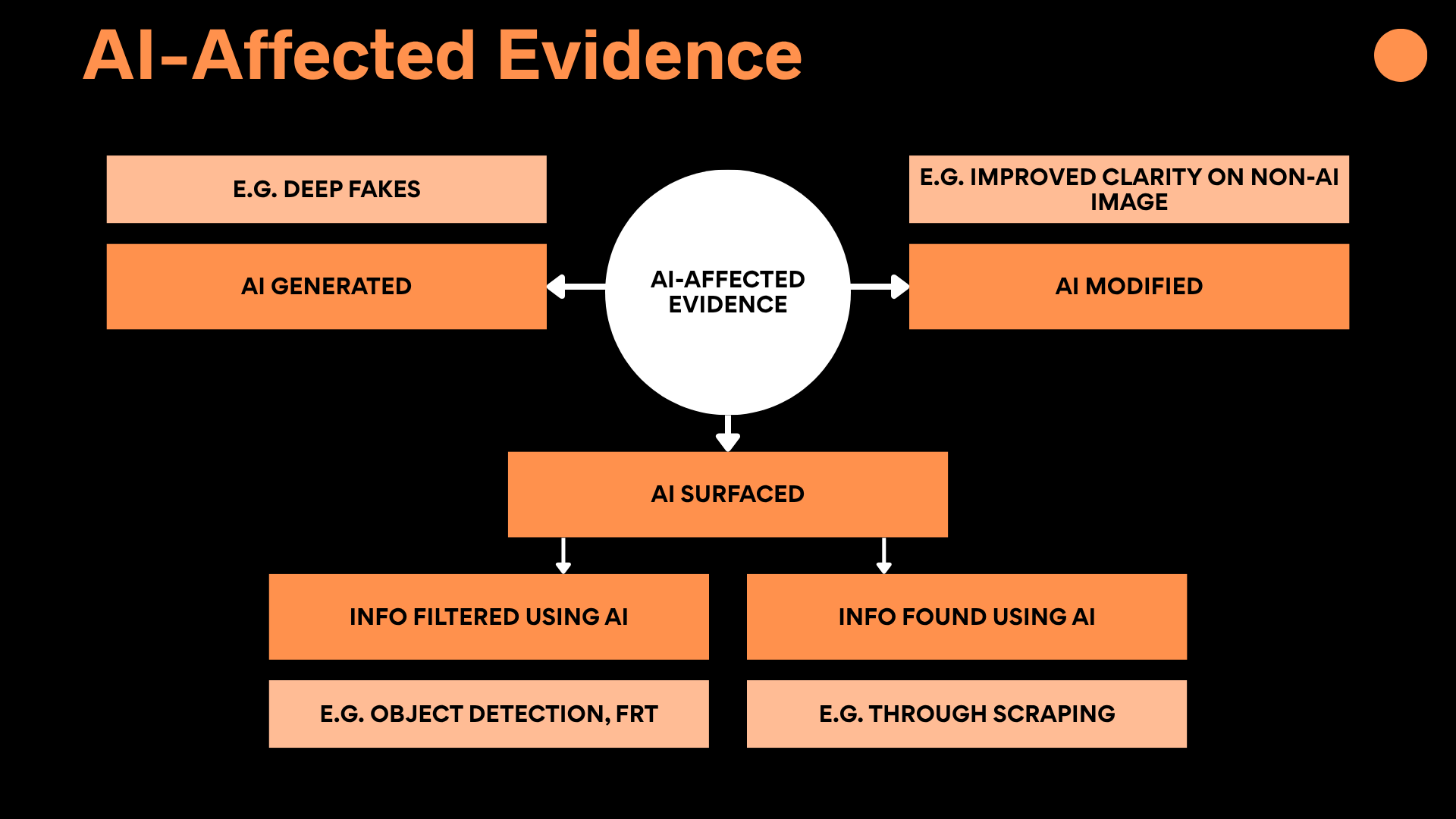
AI-generated evidence
“Evidence that is entirely synthetic, such as deepfakes.”
Key issues:
‘Seeing is believing’ effect
Inefficient/unreliable deepfake detection tools
AI-modified evidence
“Non-synthetic material that has been altered using AI, for example producing a clear image from a grainy original (e.g., superresolution satellite imagery).”
Key issues:
Blackbox effect
Undefined enhancement threshold
Widespread in mainstream AI use
AI-surfaced evidence
“Evidence that has been identified or collected through the use of AI tools. This can include filtering large collections via object recognition algorithms, or using AI-assisted data scraping for the collection of online material.”
Key issues:
Blackbox effect
Widespread in mainstream AI use - including judicial systems
Discovery of AI tools’ source code conflicts with IP
Sabrina Rewald, Basile Simon, Emma Irving, and Kate Keator, ‘When Tech Disrupts Faster Than Rules Adapt: Drafting Emergency Guidance for AI-Affected Evidence’ (OpinioJuris, 16 December 2025) <https://opiniojuris.org/2025/12/16/when-tech-disrupts-faster-than-rules-adapt-drafting-emergency-guidance-for-ai-affected-evidence/>.